

Beetle Gladiators of Northern Thailand

If you’re wandering through the villages of northern Thailand between September and November, you might spot something delightfully odd. Groups of kids and grown‑ups huddled in a circle, leaning in intently, cheering softly but not watching a ball game, not a boxing match, but two beetles. Locked horns. Pushing. Shoving. Fighting for glory.
This is chon kwaang, (beetle fighting) and it’s one of the sweetest, quirkiest, most charming traditions in the whole country. No blood, no violence, just pure strength, stubbornness, and a whole lot of heart. And the best part? When it’s all over, everyone goes home happy — beetles included.
When, Where And Who The Gladiator Beetles Are
The season lines up perfectly with the cool, misty months — late August through November, when the wet season fades and the rhinoceros beetles emerge from the forests to mate. It’s a northern tradition, strongest in Chiang Mai, Lampang, Nan, and Chiang Rai, though you’ll find it across the whole Lanna region.

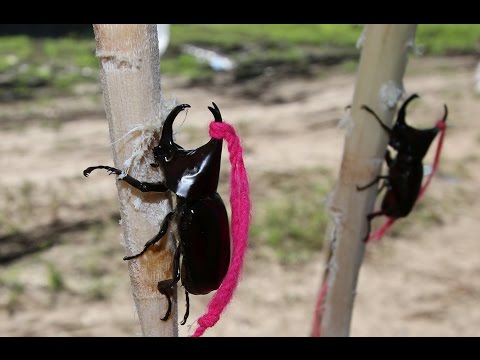
The star of the show is the Siamese rhinoceros beetle; a glossy, jet‑black giant that can grow up to 6cm long, with two magnificent horns curving proudly from its head and chest. Only the males fight and they’re absolute powerhouses. Pound for pound, they can lift 850 times their own weight. If a human had that strength, you could pick up a blue whale.
The Arena And The Rules
It’s all beautifully simple. The “arena” — called a gorn — is a smooth, cylindrical log, about a meter long and 10cm thick. At one end, a small hollow holds a female beetle, safely tucked away. Her scent drifts out, and that’s the whole reason these Gladiator Beetles are here. In the wild, males naturally lock horns to win the right to mate. This sport just lets them do what they’d do anyway, but on a stage.
Two males are placed at opposite ends of the log. They march toward each other. They meet. They lock horns. And then the pushing begins.
There are no punches, no bites, no damage. It’s pure strength against strength, exactly like sumo wrestling. The winner is the one who lifts his opponent up with his horns and flips him over, pushes him right off the log, or makes him retreat and refuse to fight. If a beetle just isn’t in the mood and walks away, he forfeits. Simple as that.
Owners have a little stick called a mai phan, not to hurt the beetle, never to strike it but to gently tap the log, creating vibrations that encourage their champion forward, or guide it left and right. It’s part coaching, part ritual. And before the match? Many owners let their beetle sip a little fresh sugarcane syrup, a traditional energy boost that’s said to make them stronger and more determined.
From Forest To Fighter
The boys catch their beetles at night, heading into the forests and rubber plantations with flashlights. The beetles are drawn to lights and to the sweet sap of certain trees so they’re surprisingly easy to find. The trees are shaken and they drop harmlessly to the ground where they’re collected.
A good beetle is chosen for his size, the shape of his horns, and his confidence. Once home, he gets his own little container, regular fresh fruit and sugarcane, and plenty of rest. Some owners keep them for the whole season and when the fighting’s done, they take them back to the forest and set them free.
These aren’t disposable pets, rather they’re respected opponents. Many owners name their champions “Black Horn,” “Mountain King,” “Iron Head” — and talk about them with real pride.
Big Tournaments And Community spirit
What started as kids playing in the yard grew into something much bigger. Villages hold tournaments, while in Pua district in Nan province hosts an annual festival every September that draws crowds from across the region.
Doi Lor in Chiang Mai even calls theirs the “World Fighting Beetle Championship”, which has been running for over 12 years. It’s all in good fun, and the atmosphere is warm, excited, and entirely family‑friendly.
For the villages, it’s more than a game. It’s a way to stay connected to the land and the seasons; something to look forward to as the rains end and the cool, pleasant winter arrives. And yes there’s betting, but while some of it is mostly small stakes between friends, some punters can make huge sums, in much the same way as others do in cock-fighting.
Why It’s So Wonderful And Why It’s Different
There are lots of animal sports in the world. But this one feels different. The beetles aren’t hurt. They’re not forced into something unnatural, they’re doing what male beetles do every day in the forest, just on a slightly fancier log. When the match ends, the winner and the loser both walk away perfectly fine. Many get to go back to the jungle when the season’s over.

It’s gentle. It’s quiet. It’s children learning about nature, patience, and respect for living things. It’s grown‑ups laughing over something simple, forgetting their worries for an hour. And it’s all based on the most natural, ancient instinct in the book, two males competing for a female, with nothing but honour and horns.
Next time you’re in the North in the cool season, keep an eye out for those little circles of quiet excitement. You might see two tiny gladiators going head to head — and you’ll be watching what used to be one of the sweetest, most harmless traditions in all of Thailand. No one gets hurt, everyone has fun, and at the end of the day the beetles go home. Perfect – at least it was.
Now They Fight For Survival
However not all is sweetness and light; the beetles have begun to decline in numbers, partly due to habitat loss, partly due to too many of them not surviving their treatment at the hands of clumsy humans, and more recently becoming a popular snack at local food stalls. But a hero awaits…
An elderly man named Pairath Disthabamrung gets up early every day as he has important work to do. He has about 600 special guests to feed and care for. Because the beetle is slowly dying out, Pairath decided to help them by breeding them in captivity to increase the population.
Over the past decade, he has devoted himself to preserving this rare species, as well as breathing new life into the beetle fighting tradition unique to the villages of the north. His efforts have reaped some rewards. The beetle fighting festival in Nan was added to the annual list of Nan provincial traditions by his request.
The Hercules Beetle Club of Thailand, the first ever club of its kind, was inaugurated in 1996 with members from seven Northern provinces. His next challenge was to breed the species in captivity and then export the insect to Japan where they will be kept as pets.

As for how that went, I have no idea but at least the beetle fighting tradition still continues to this day, and it’s popularity is reflected in the fact that Chiang Rai United football team call themselves “The Beetles”.