

The Mystery Of The James Bond Car Stunt – Solved?
James Bond in Thailand
Thailand has always held a special place in James Bond history. Its tropical islands, crowded Bangkok streets, canals and busy markets provided the exotic background for several 007 adventures, from “The Man with the Golden Gun” in 1974 to “Tomorrow Never Dies” in 1997.
But Bond films rarely obey ordinary geography. In “The Man with the Golden Gun”, Bond escapes from a Muay Thai stadium in Bangkok and soon appears in the canals on the other side of the river in Thonburi, and not much later in Rangsit, north of the city.

In “Tomorrow Never Dies”, Bangkok stands in for Vietnam, with locations such as Mahatun Plaza and Thonburi’s Sinn Sathorn Tower transformed into the streets of Saigon.
Most of these filming locations are all well known. One, however, remained surprisingly hard to pin down: the place where Bond’s AMC Hornet performed one of the most famous car stunts in cinema history.
A Jump That shouldn’t Have Worked
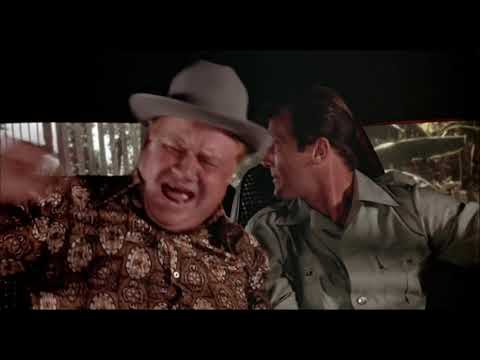
The scene begins with Bond and the unfortunate Sheriff J.W. Pepper fleeing across the countryside. Their route is suddenly blocked by what appears to be a damaged bridge. There is no time to stop, so Bond reverses, accelerates and sends the red AMC Hornet across the gap.
In mid-air, the car rotates around its long axis in a complete corkscrew motion before landing upright on the opposite side. It happens so quickly that the stunt can be easy to underestimate. The car is not merely jumping forward; it is twisting through the air while travelling from one ramp to another. If things had gone wrong it could have ended differently.

The stunt was performed by Loren “Bumps” Willert on 1 June 1974, the thirty-fifth day of production. He completed it in a single take, with dummies representing Bond and Sheriff Pepper positioned on either side of him. Willert wore black so that he would disappear into the background, leaving the illusion that Roger Moore and Clifton James were inside the car. Eight cameras recorded the action, allowing the spectacular movement to be studied later in slow motion.

Willert was reported to have been paid a US$30,000 cash bonus on the spot, for successfully performing this iconic corkscrew car stunt for the 1974 James Bond film The Man with the Golden Gun.

The jump became known as the “Astro Spiral”, a stunt originally developed for American thrill shows. It had already been demonstrated in the United States, but reproducing it for a film in rural Thailand required much more than simply building two ramps and hoping for the best.
How The Stunt Was Created
Remember, this was in the 1970s, there was no AI, little CGI, and the stunt had to be done by a real person taking a real risk.
The idea reached director Guy Hamilton after stunt driver Joie Chitwood showed him a photograph of a car performing a corkscrew jump. The original stunt had been developed by American driver and showman Jay Milligan, who had performed an early version at the Houston Astrodome in 1972 using an AMC Javelin. The Bond production licensed the idea and adapted it for the film.
The dangerous part was that the stunt could not safely be developed through trial and error. A small mistake in the ramp angle, speed or balance of the car could send the vehicle into the canal or cause it to land on its roof. Instead, the production turned to Raymond McHenry and the Calspan Corporation in New York.
Calspan had developed a computer simulation called the Highway Vehicle Object Simulation Model, or HVOSM. It was designed to model the movement of vehicles during crashes and other violent manoeuvres. For the Bond jump, the system was used to calculate the launch angle, landing angle, speed, rotation and balance required to bring the Hornet back onto its wheels.
The calculations indicated that the car needed to approach the ramp at approximately 48mph (about 77kph). Two tachometers were fitted inside the vehicle so the crew could check its speed. The driver’s position and the steering wheel were moved to the centre of the car to keep the weight evenly distributed, while the Hornet was fitted with a roll cage and other essential modifications for the jump, including a hidden 5th wheel.
The computer modelling also predicted the car’s roll velocity and flight path. In an era when home computers were still rare for most people, the stunt was being planned with mathematical simulations and crude wire-frame visualisations.
It is often described as the first computer-modelled stunt in film history, although the important point is that the computer was not creating the jump on screen. It was helping the crew design a real stunt that would then be performed by a real car and driver.
The production team located a suitable canal in the rural Rangsit area north of Bangkok. They constructed a pair of carefully calculated ramps and disguised them as the remains of a broken bridge. Scrap wood and a Thai-style house were added to make the site look like part of the countryside rather than a purpose-built stunt set.
Once the jump had been completed, the temporary structure was dismantled. This decision helped create a mystery that lasted for decades. The film preserved the image of the bridge, but the bridge itself disappeared almost immediately.
The Search For The Lost Location
In the 1970s, the area north of Bangkok was still largely rural. Dirt roads ran beside the many irrigation canals, and there were few permanent landmarks to help future visitors identify the location.
The Rangsit canal (Khlong in Thai) system was one of Thailand’s important early irrigation projects. Its network of straight waterways made the area ideal for filming, but also created a problem for later investigators: many canals look similar, and the surrounding landscape has changed almost beyond recognition.
Over the years, online maps and location guides produced several conflicting answers. Some coordinates pointed to the broad main channel of Khlong Rangsit Prayunsak. That location wasn’t right because the waterway is too wide for the jump shown in the film. A car travelling at 48mph would have fallen short or landed in the canal leaving 007 and Sheriff Pepper a bit wet.
Other coordinate markers were placed right at a temple called Wat Saeng San. That mistake is understandable as it was used as a base for the film crews and, before satellite navigation, a temple would have been an obvious meeting point for a film crew in a rural area.
Local memories connected the production with the temple; A monk later recalled the crew using the area and said that Roger Moore had been there. The temple was also used for storage, while a mockup of Scaramanga’s car turning into an aircraft was filmed at the rear of the temple.

In this video, we see Scaramanger driving into Wat Saeng San beside Khlong 2 in the Rangsit irrigation zone, indicating that a lot of scenes were shot there or nearby.
But the jump itself could not have taken place directly in front of the temple. The scene requires a long approach road on one side of the canal and enough space for the car to land on the other. A temple building or compound in the wrong position would have blocked either the run-up or the landing area.
The most promising answer to our mystery emerged from combining local memories, old roads, canal width and the geometry of the jump. The search eventually focused on a narrower section of Khlong 2, running alongside Wat Saeng San and Udomwittayalai School.
A modern footbridge near Wat Saeng San provides a useful alignment across the canal. From the bridge, the view points toward Udomwittayalai School, which was built in the 1950s. This places the likely site roughly 350 meters south of the main temple grounds rather than directly beside the temple.
The roads on both sides of the canal are also important. The film shows Bond approaching from one bank and landing on the opposite side. Khlong 2 is narrow enough to match the visible flight of the Hornet, while roads appear to have existed along both banks since the canal area was developed. It also appears likely that the stunt crew built the landing site over part of the waterway and disguised it with plants to make the jump narrower – you can see this in the video.
Urbanisation then concealed what little evidence remained of this unique and exciting piece of action. Flood barriers replaced older canal edges, houses spread along the roads, and a busy market occupied the possible landing area on the eastern bank. Wooden buildings and shanties also obscured the western approach road. Anyone searching from the modern road would have found it difficult to recognise the open rural landscape seen in the film.
The recent demolition of the market briefly exposed the eastern bank again, (although rebuilding has already begun). That cleared view makes it possible to compare the modern landscape with the film and to see how the old road, canal and landing area could have fitted together.
The Location Revealed
The best match is not the wide main Rangsit canal and not the ground immediately outside Wat Saeng San. It is a narrower section of Khlong 2, past the footbridge and Udomwittayalai School, closer to Khlong Rangsit.
Standing on the western canal bank today, the modern scene looks nothing like the open countryside of 1974. Concrete flood barriers, houses, roads and new construction have replaced the dirt tracks and temporary film set. Yet the geometry remains: the canal is the correct width, the roads occupy the necessary positions, and the line from the old approach to the landing bank fits the movement of the Hornet.

In the above photo of Khlong 2, the watergate and the flood walls didn’t exist just a couple of years ago, and the location of the car jump site is about 1km beyond the Watergate where the canal is narrower.
The location we suggest should be treated as the strongest evidence of the right place for the stunt so far, rather than an officially confirmed film-location marker. The original ramps and bridge were removed, and there is no surviving sign identifying the exact take-off point. Nevertheless, the physical evidence makes this section of Khlong 2 a much more convincing answer than the broad main canal or Wat Saeng San itself.
For a few seconds in 1974, Loren “Bumps” Willert drove an AMC Hornet into the air and turned it into a flying corkscrew. The computers had predicted the movement, the temporary bridge had disguised the machinery, and the car landed exactly as planned.
Then the crew dismantled the evidence and left.
For half a century, the stunt survived only on film. Now, beneath the development of modern Rangsit, the lost Bond jump can finally be placed on the map, at 13°59’28.5″N, 100°38’31.2″E – this, we believe, is the nearest possible point to where the scene was shot.
That’s an interesting story, I never knew how they set that stunt up but it’s still pretty amazing. I don’t know that area you guys have identified but it would be nice to go see it.